How to make your money Wrapped with Claude

Hey, it's Collin. You commented WRAPPED, so here's the whole thing: the skill, a copy-and-paste version, and what to delete first.
This guide is for general education and is not personalized investment advice. Your situation is unique. Consider talking with a qualified professional before making financial decisions.
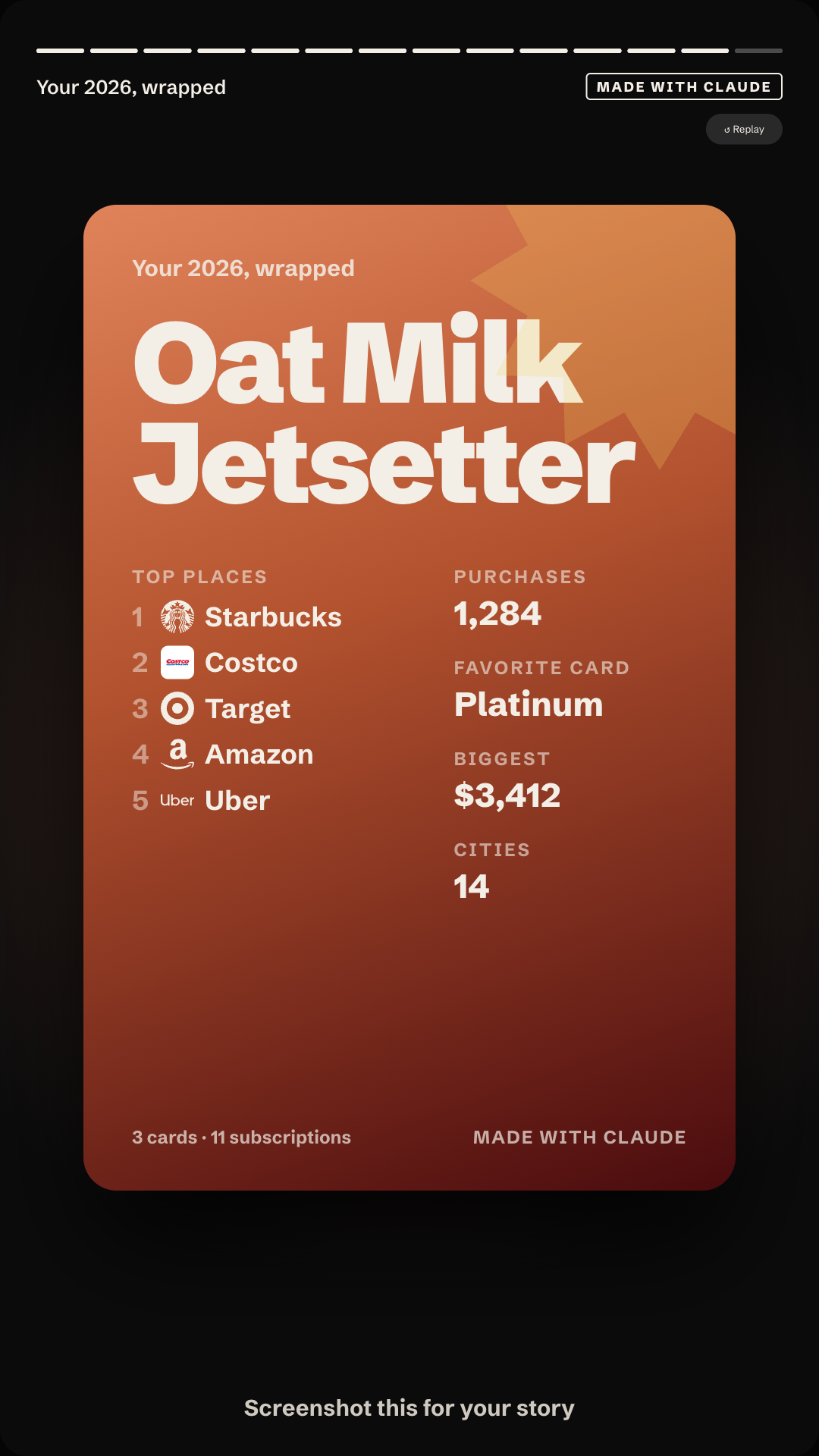
Spotify Wrapped, but for your credit cards. You give Claude your card statements, and it turns your year into a tap-through story: how many times you paid for something, your ride-or-die card, your #1 stop, where your card traveled, your biggest purchase, the subscriptions still running, and a money personality it makes up just for you. The last slide is made to screenshot for your Instagram story. You can add it as a skill or just copy and paste one prompt; both are below.
- Time
- About 10 minutes (5 to download your statements, a few for Claude)
- Cost
- Free to use. Tested on a paid Claude plan; on the free plan, a big year of statements can hit the usage limit.
- You need
- Your card statements as CSV files, and Claude (app or claude.ai)
- You get
- A tap-through story of your year, plus a share card for your story
what you'll get
The result
Never paste account numbers, your name, Social Security number, date of birth, address, or login details into any AI tool.
Card CSVs usually show only the date, the store and the amount. Open each file before you upload and delete any column with a card or account number, your name or your address. Delete any rows you'd rather Claude not see, too.
pick your way
Two ways to do it
Both make the same kind of story from the same files. Neither is better; it comes down to whether you want to install something.
Add the skill
- One-time install, then type /wrapped
- Same polished design every time
- Counts come from a tested script
Best if you'll do it again or share it with friends.
Download the skillCopy the prompt
- Nothing to install
- Paste it with your files and send
- The design changes a little each time
Best if you just want to try it once, fast.
the whole thing in 3 steps
Quick start: three steps
-
Download your statements
In your bank's app or website, open a card's activity, find Download or Export, pick CSV, and choose this year. Do it for each card. Name each file after the card, like
amex-gold.csv. -
Pick your way
The skill: download wrapped.zip, then in Claude go to Settings, Capabilities, turn on Code execution and file creation, and under Skills choose Upload and pick the file. One time only.
Or the prompt: copy it from the box below. Nothing to install.
-
Send it
Start a new chat and attach your CSV files. Type /wrapped (skill) or paste the prompt, and send. Tap through your story when it's ready (right side for next, left for back, hold to pause).
That's it. Screenshot the last slide and post it.
for the copy-and-paste way
The prompt
Copy this, paste it into a new Claude chat with your CSV files attached, and send.
Make me a "Wrapped" for my money: like Spotify Wrapped, but for my credit cards. I attached one CSV per card, and each file is named after its card.

**Step 1. Read my files carefully.** Use code to analyze them if you can. Count purchases only. Leave out payments, interest, late fees, annual fees, balance transfers and refunds. Figure out each file's sign: payments show the opposite sign of purchases. Find:
- total number of purchases, and number of different places
- each card's share of my purchases
- my top 5 places by visits (clean the names: "SQ *BLUE BOTTLE 123" is Blue Bottle)
- my busiest single day (date and number of purchases)
- my biggest and smallest single purchase
- subscriptions still running: the same amount on about the same day each month, at least 3 months, still charging in the last 40 days. Note any that raised their price, and any gym.
- the cities and countries where I paid for something (from the merchant text and any foreign transaction fees)
- anything surprising: delivery orders, returns, a long coffee streak, places I tried only once, my busiest month, weekend vs. weekday

Leave bills off every slide: insurance, rent, utilities, phone, loans, taxes, medical. Don't repeat account numbers. Never show yearly spending totals; single purchases and counts are fine.

**Step 2. One live search.** Look up the latest Federal Reserve "Diary of Consumer Payment Choice" for the average number of credit card payments per person per month. Multiply by 12 (scale it down if my files cover part of the year) and compare it with my purchase count. Put the source in small print on that slide.

**Step 3. Pick 10 to 14 slides**, in this order, skipping any that would be zero or boring:
1. Title: the year huge, "Your money, wrapped."
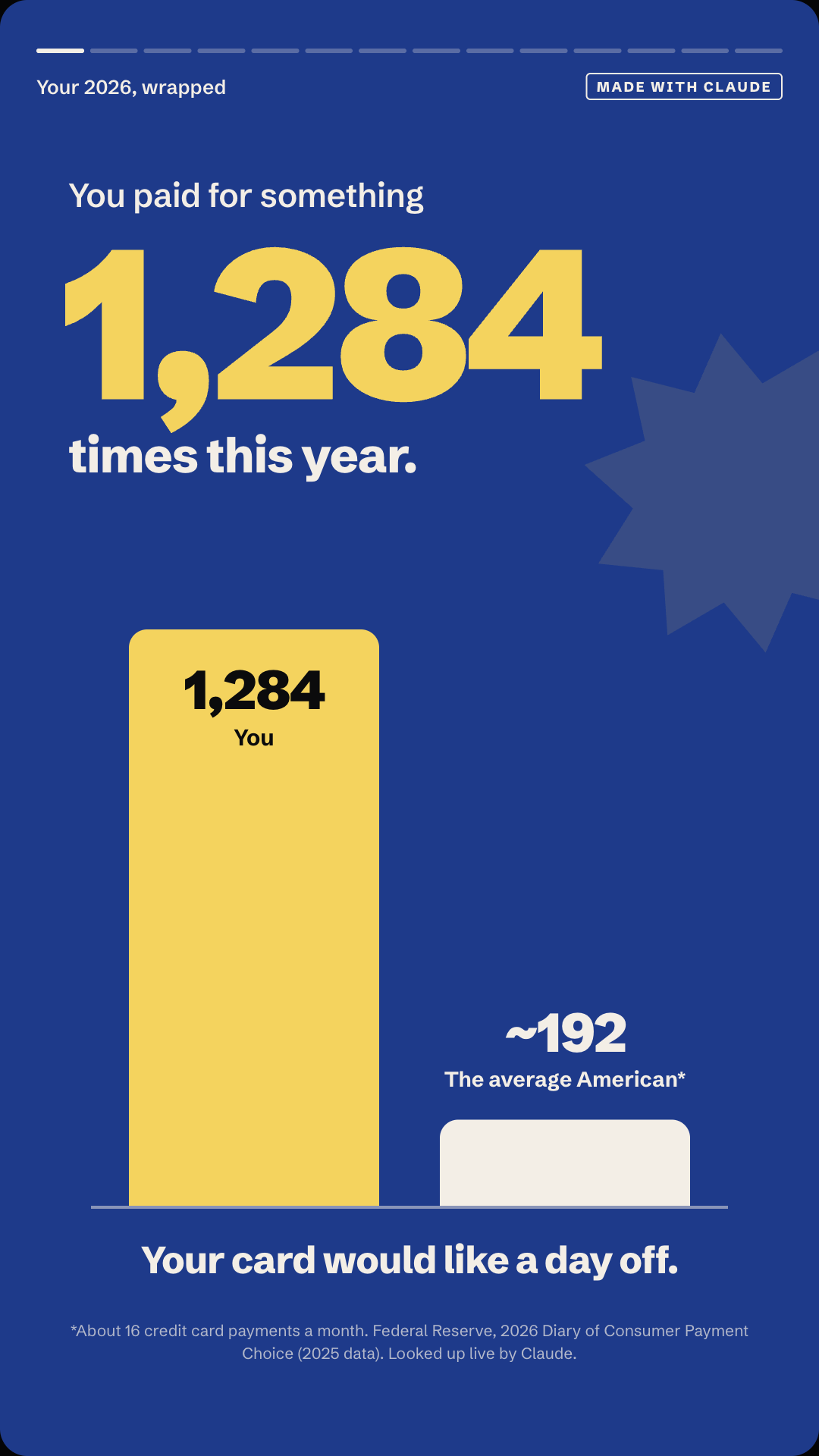
2. "You paid for something [N] times this year." A tall bar for me next to a short bar for the average American, with the source line.
3. Your busiest day: the date huge, "[N] purchases. One day.", a year of small squares with that day lit up.
4. Your ride-or-die card: the cards fanned in 3D, the winner in front, its share of purchases, a bar for each card. Draw each card yourself in the card's general look (metal silver, gold, navy, graphite, black), not a copy of real card art.
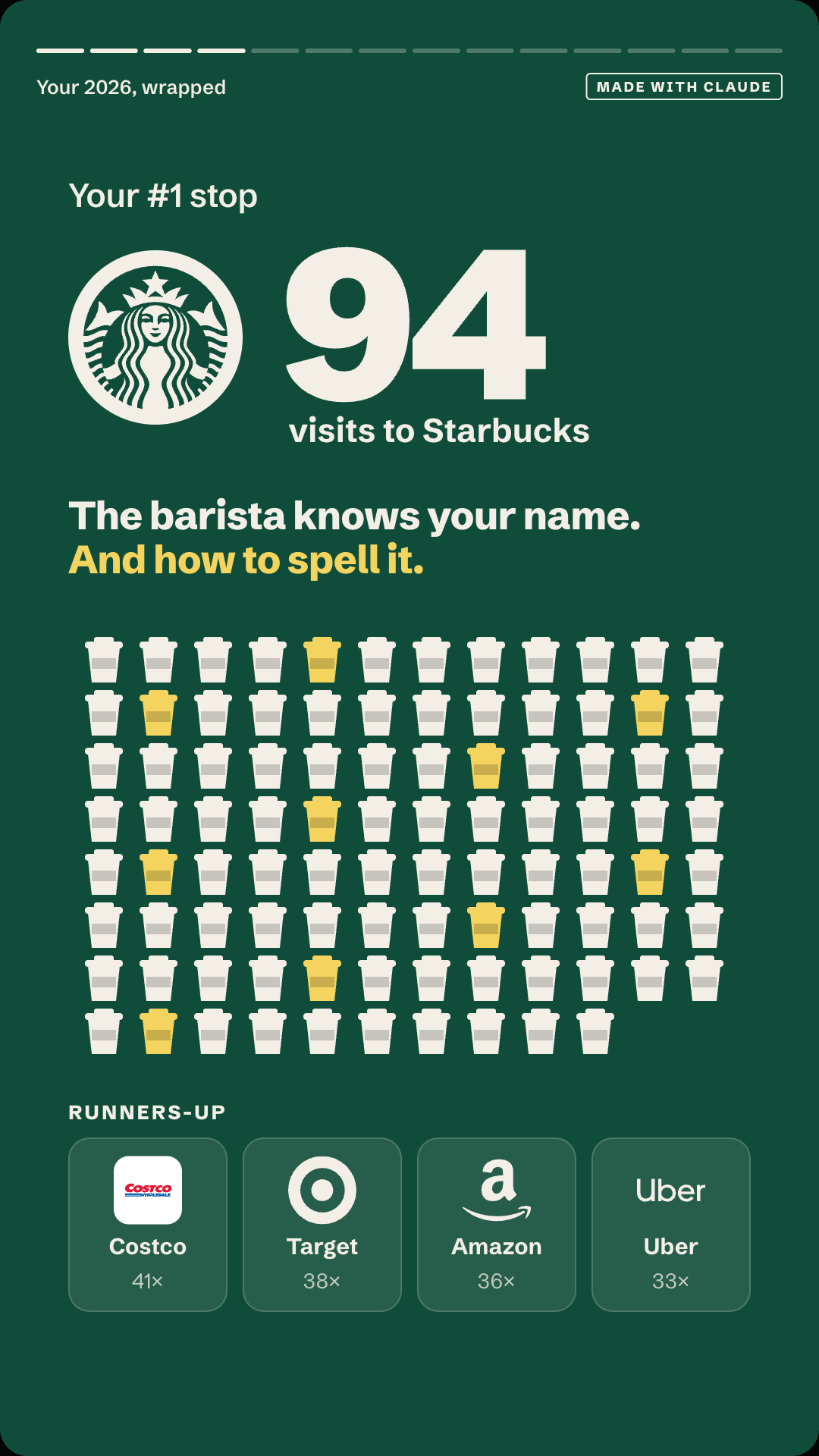
5. Your #1 stop: the place, the visit count, one small icon per visit, then the runners-up.
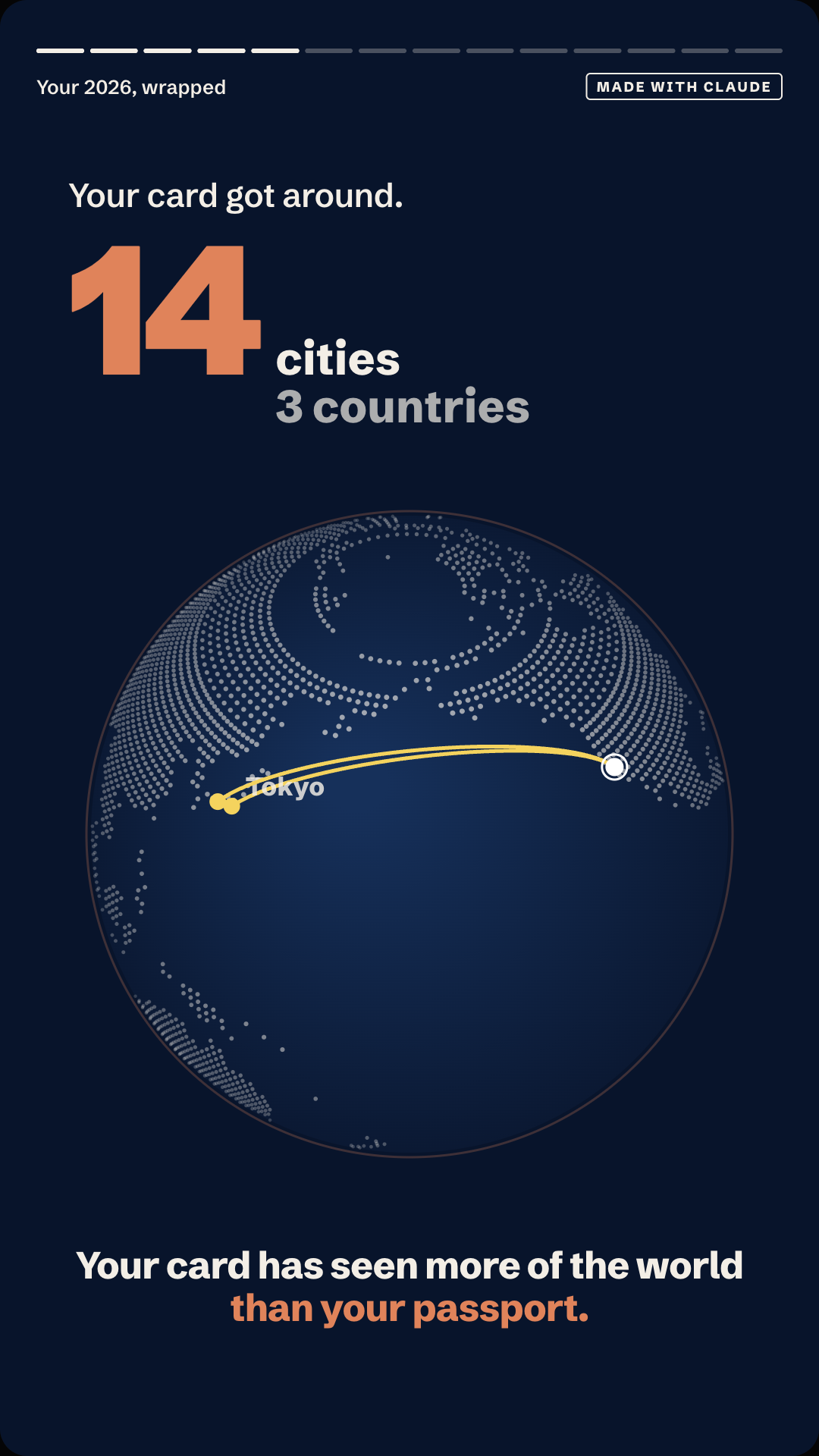
6. Your card got around: a dotted globe with arcs from home to each city, "[N] cities, [N] countries".
7. Your biggest single purchase: the amount huge and a receipt that prints down the screen.
8. Two to four surprises from Step 1, each as one big number plus a picture of it (a grid of little bags for deliveries, boxes for returns, a row of squares for a streak, bars for months or weekdays).
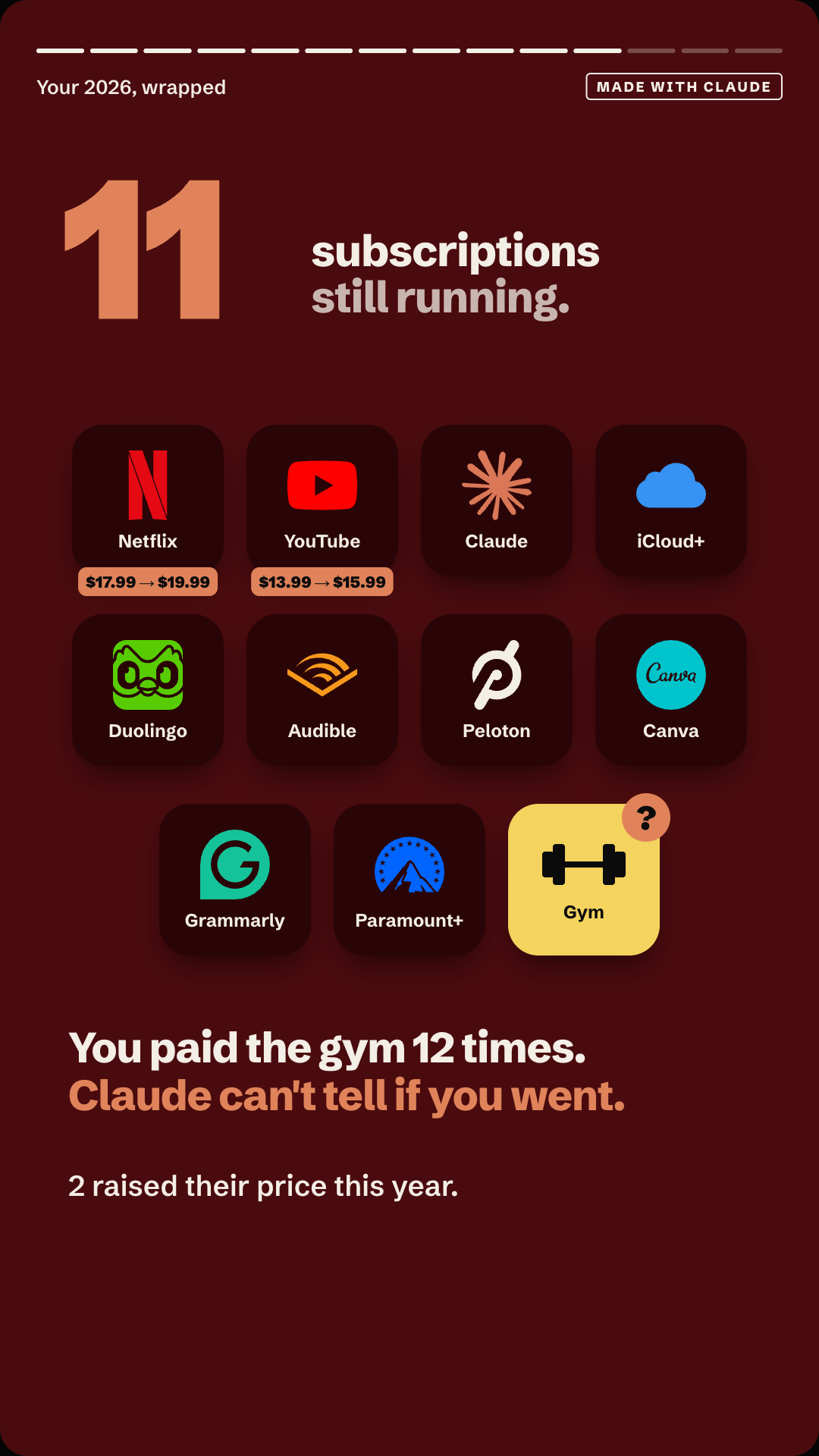
9. Subscriptions still running: the count huge, a grid of tiles with each one's logo or first letter, a price tag on any that went up.
10. Your money personality.
11. The share card (last).

**Step 4. Write it funny.** One short joke per slide, under 45 characters a line, warm and a little roasty, never mean, using my real details. Examples of the tone: "The barista knows your name. And how to spell it." "Costco can do that to a person." "Your driver knows the gate code." "You paid the gym 12 times. Claude can't tell if you went." "We're not going to ask." No advice, no "you should", no "you could have saved", no judging debt or habits. No em dashes.

**Money personality:** invent a fresh, funny 2 to 3 word title from my top two or three patterns, the way a friend would nickname me (a big coffee habit plus a lot of travel could become "Oat Milk Jetsetter"; make up your own, don't reuse that one). Add one line under 60 characters and three chips with real numbers, like "94 lattes", "14 cities", "Saturday spender".

**Step 5. Build it as one interactive HTML artifact.**
- A 1080 by 1920 story frame, scaled to fit the screen, with rounded corners and a dark background around it.
- Font: "Schibsted Grotesk" from Google Fonts, falling back to the system font. Huge numbers at weight 900 with tight letter spacing; labels at weight 600.
- Each slide gets one bold background from this palette, never two in a row the same: ink #0B0B0C, cobalt #1E3A8A, coral #E0835A, forest #0F4D3A, navy #08142B, butter #F4D35E, oxblood #4A0B0E, bone #F3EEE6, teal #0B3B3A. Text is bone on dark slides and ink on light ones. Accent numbers in butter or coral. No neon, no rainbow gradients.
- Story progress bars across the top and a small header: "Your [year], wrapped" on the left, a "MADE WITH CLAUDE" chip on the right.
- Tap the right side for next, the left side for back, hold to pause. Each slide plays about 5 seconds, then moves on by itself.
- Everything animates in: numbers count up, bars grow, icons drop in with a little bounce, the big title slams in. Nothing overlaps, and nothing touches the screen edges.
- Use each company's real logo wherever it appears (the #1 stop, runners-up, biggest purchase, subscriptions, and next to the top places on the share card). Load it as an image from `https://cdn.simpleicons.org/<brand>` (for example starbucks, target, amazon, netflix, uber). If a brand isn't there, like Chipotle or Costco, search for its current official logo on Wikipedia and use the direct `upload.wikimedia.org` image link. Show full-color logos on a small white rounded tile so they read on any background. If an image doesn't load, show the brand's first letter in a circle instead.
- The share card: a coral-to-oxblood card with the personality huge, top 5 places with their logos, and four facts (purchases, favorite card, biggest purchase, cities), plus "Screenshot this for your story" under it and a Replay button.

When it's done, tell me in two sentences how to use it, and end with "Just for fun, not financial advice."
what Claude looks for
What's inside
Every story gets the basics: your purchase count (next to the average American's, looked up live from the Federal Reserve), your ride-or-die card, your #1 stop, your subscriptions and your money personality. Then Claude picks the most surprising extras for you from these:
- your busiest day
- where your card traveled, on a spinning globe
- your biggest and smallest purchase
- delivery orders
- returns
- new places you tried
- your longest coffee streak
- your busiest month
- weekend vs. weekday
- you vs. last year (send last year's statements too)
- foreign card fees
Real brand logos show up where they fit. Bills like insurance, rent and taxes are left out on purpose.
the honest part
It reads where you paid, not what you bought
- Store names are best guesses. Banks shorten them ("SQ *BLUE BTL 123"). Claude cleans them up, but check anything that looks off.
- Cities and subscriptions are guesses too. Travel comes from the store name and foreign fees. A yearly subscription, or one billed through Apple or Google, can hide.
- No yearly totals, on purpose. The story shows counts and single purchases, so the share card is safe to post.
- Free plan limits. A full year on several cards is a lot of rows. If Claude stops partway, try one card at a time or a paid plan.
- The skill needs Code execution turned on. If /wrapped doesn't show up, check Settings, Capabilities.
keep it in perspective
A look back, for fun
This is a look back at where your money went, for fun. It isn't a budget, a plan or advice.
- Patterns, not judgments. A lot of coffee or delivery is just your year, not a grade.
- Check before you act. If something surprises you, like a subscription you forgot, look at the statement itself before you cancel or change anything.
- The comparison is a rough one. "The average American" counts credit card payments only, from the Federal Reserve's survey, and everyone's life is different.
Tested with Claude, November 2026.
Note: Claude is a product of Anthropic, and Spotify Wrapped is a Spotify feature. I'm not affiliated with either and I'm not paid to mention them. Card and brand names and logos belong to their owners; the cards in the story are drawings, not real card art. Pictures on this page use sample data.
Sources: Federal Reserve Financial Services, 2026 Diary of Consumer Payment Choice (2025 data): about 16 credit card payments per consumer per month.